
Subscribe to our new Newsletter for Certification Body Professionals & ISO Auditors → Here
The transition period for ISO/IEC 17020:2026 is already running, and some accreditation bodies like DAkkS accepts transition applications from 1 November 2026. TIC OS gives certification and inspection bodies one place for procedures, competence records, audit planning and assessment ready evidence, from application to certificate.
The 2012 editions of the conformity assessment standards are being replaced one by one. These dates are confirmed by ISO, DAkkS and UKAS:
ISO/IEC 17065: DAkkS will publish transition guidance once the German version of the revised standard is published by DIN.
A new standard edition is more than a document update. Your accreditation body expects you to show that the changes are understood, implemented and working before the transition assessment. DAkkS asks inspection bodies to document their transition arrangements and a transition plan, and UKAS asks for a gap analysis proforma at least one month before the assessment. In practice, most bodies will work through the same steps:
Compare the new edition with your current management system and decide what needs to change.
Update the manual, procedures, checklists, report and certificate templates, and contract documents. Keep meeting the old edition until your new accreditation is granted.
Show how you identify and monitor risks to impartiality, and how you make sure competent personnel are available, including external auditors and inspectors.
Be ready to explain how you control data and information, how you validate and secure the software you use, and how you oversee any AI.
Prepare traceable records that assessors can sample without days of document chasing.
Make sure staff affected by the changes understand the revised requirements.
UKAS highlights among other things: the independence types are simplified to Type A and Type non A, impartiality requirements are strengthened, a new section covers data and information control (including software validation and security), controls on externally provided services are broadened (including provider registers), and risk and opportunity management replaces preventive action.
ISO/IEC 17024:2026 goes further on AI. According to UKAS, it requires certification bodies to validate, oversee and disclose their use of AI, with human oversight of AI outcomes. This is a clear signal of what accreditation bodies will ask about the tools you use.
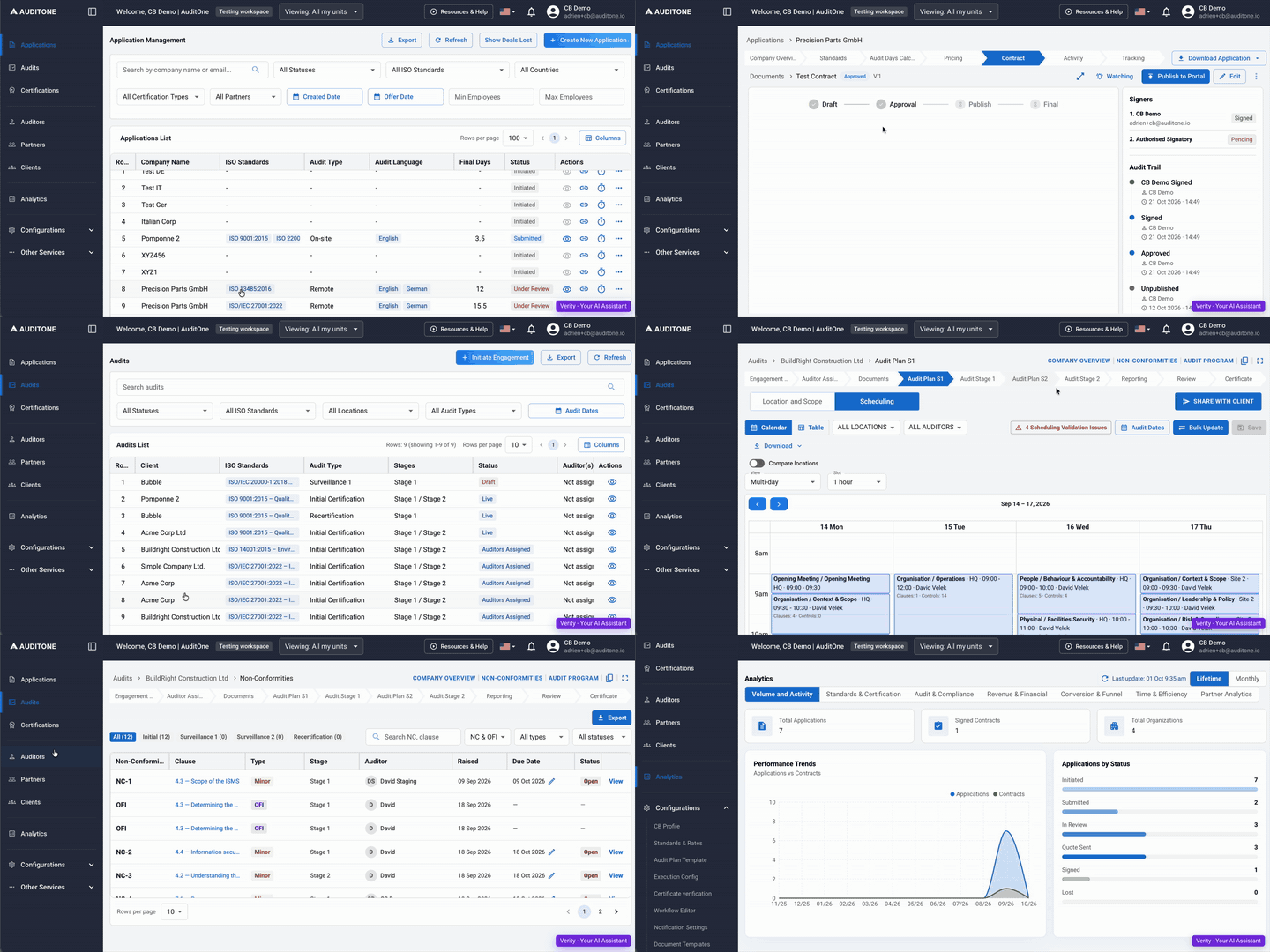
TIC OS is AuditOne's AI native operating system for certification and inspection bodies. It covers ISO/IEC 17021, 17020 and 17065 service types in one platform, from application and contract review through planning, scheduling, fieldwork and reporting to the certification decision and certificate issuance.
Application intake, contract review, Stage 1 and Stage 2 planning, surveillance, recertification and transfer audits, reporting, decision and certificate all run in one connected system. When your procedures change, you update templates and workflows once instead of fixing spreadsheets, Word files and email templates one by one.
Configure sector specific checklists, report, quote and contract templates, and report language per client. You can add custom templates for any standard or scheme, so your updated documents go live across all new audits at the same time.
Each auditor profile holds skills, credentials, sector codes and conflicts of interest. Auditors upload their qualification documents, and you review and verify them in the platform. Lead auditors and reviewers are suggested based on scheme, industry and language, and competence management follows IAF MD 7. External auditors are recorded in the same structured way as your own staff.
Every action is logged with timestamp and IP address and can be exported for your accreditation assessments. Evidence is linked to findings, clauses and controls, with version history. Retention periods can be set per scheme or client. Data is encrypted in transit and at rest, access is role based with two factor login, and data is hosted in the EU by default (self hosting is available). AuditOne is ISO/IEC 27001 certified.
The AI Stage 1 agent reviews client documents and flags missing evidence. AI tags notes to clauses and suggests audit questions and findings based on expectations you configure. Your auditors and decision makers stay in control: suggestions are reviewed, manual overrides are always possible, and adjustments are logged next to the original values. This is the kind of oversight accreditation bodies increasingly want you to be able to show.
Audit days are calculated per IAF MD 5 and multisite sampling follows IAF MD 1. Overrides are logged. Dashboards show audit activity, planning time and document turnaround. When transition work and regular audits peak at the same time, you can publish an audit to AuditOne's network of 1,500+ vetted ISO and security auditors for a specific sector code, language or extra capacity.
Demand for accredited AI management system certification is growing. Many certification bodies are now planning a 42001 scope extension, often while they handle their standard transitions.

In October 2026, TÜV AUSTRIA announced full accreditation for ISO 42001, and Bureau Veritas published details of its ISO/IEC 42001 accreditation by Accredia.

TIC OS supports ISO/IEC 42001 alongside ISO 9001, ISO/IEC 27001, ISO 14001, ISO 45001 and other schemes. Combine 42001 with existing standards in integrated audits with separate audit days and pricing per standard, shared evidence collection and nonconformities linked across clauses.

Record auditor competence for the new scope, and use the auditor network when you need additional capacity.





When do I have to transition to ISO/IEC 17020:2026?

ISO/IEC 17020:2026 was published on 27 March 2026. Accreditations to the 2012 edition generally cease to be valid on 27 March 2029. In Germany, DAkkS accepts transition applications from 1 November 2026, starts assessments in January 2027 and recommends completing the transition assessment by 27 March 2028 at the latest. UKAS makes assessments to the 2026 edition mandatory from 1 January 2028.
Has ISO/IEC 17065 been revised?
Yes, a revision is close to publication. The final draft ballot closed in late October 2026, and ISO currently lists the standard as "under publication", with publication expected by the end of 2026. DAkkS will publish transition guidance once the German version is available from DIN. Until then, ISO/IEC 17065:2012 remains the edition in force.
What does ISO/IEC 17024:2026 require on AI?
According to UKAS, ISO/IEC 17024:2026 adds definitions such as "artificial intelligence" and "bias", requires bodies to manage impartiality risks in their use of AI, and includes a new clause requiring certification bodies to validate, oversee and disclose AI use, with human oversight. UKAS assesses to the new edition from 1 January 2027, makes it mandatory from 1 January 2028, and 2012 accreditations cease to be valid on 1 April 2029.
How should a certification or inspection body prepare for the transition assessment?
Start with a gap analysis against the new edition. Then update procedures and templates, review impartiality and competence records, train affected staff and collect traceable evidence of implementation. DAkkS also expects documented transition arrangements and a transition plan, and UKAS asks for a gap analysis proforma one month before the assessment.
Does TIC OS make my body compliant with the new standards?
No software can do that for you: compliance depends on your processes and decisions. TIC OS gives you one system for workflows, templates, competence records and logged evidence, so implementing the changes and showing them to your assessor takes far less manual effort.
Can TIC OS support an ISO/IEC 42001 scope extension?
Yes. ISO/IEC 42001 is included in TIC OS's standard setup. You can plan and run 42001 audits on their own or as part of integrated audits, record auditor competence for the scope and add capacity from AuditOne's auditor network.
See how TIC OS supports ISO/IEC 17021, 17020 and 17065 workflows, from application to certificate, with records your assessor can follow.


